Project Overview
This project was developed during my manufacturing internship at Siemens Healthineers, where a packaging line was folding shipping boxes entirely by hand: roughly 10 seconds per box across 15,000 units a month, tying up about 41 hours/month in repetitive labor and repetitive-motion strain. The goal was to design and prototype a robotic station that could fold the box automatically and free that time for higher-value work.
The solution follows a simple Feed → Fold → Drop pipeline: boxes are loaded from a stack, the station erects the box and folds the bottom flaps into a sealed shape, and the finished box is moved off to a bin.

Mechanical Design
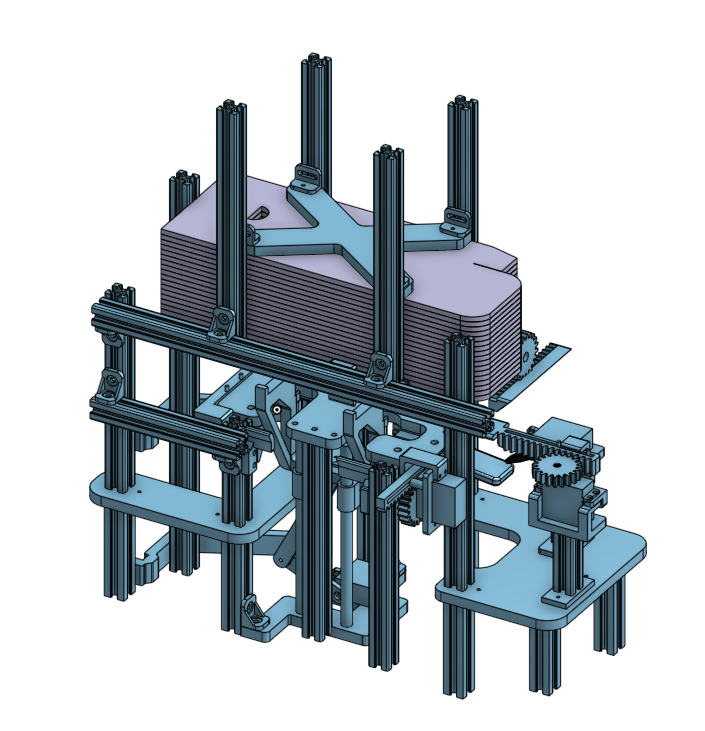
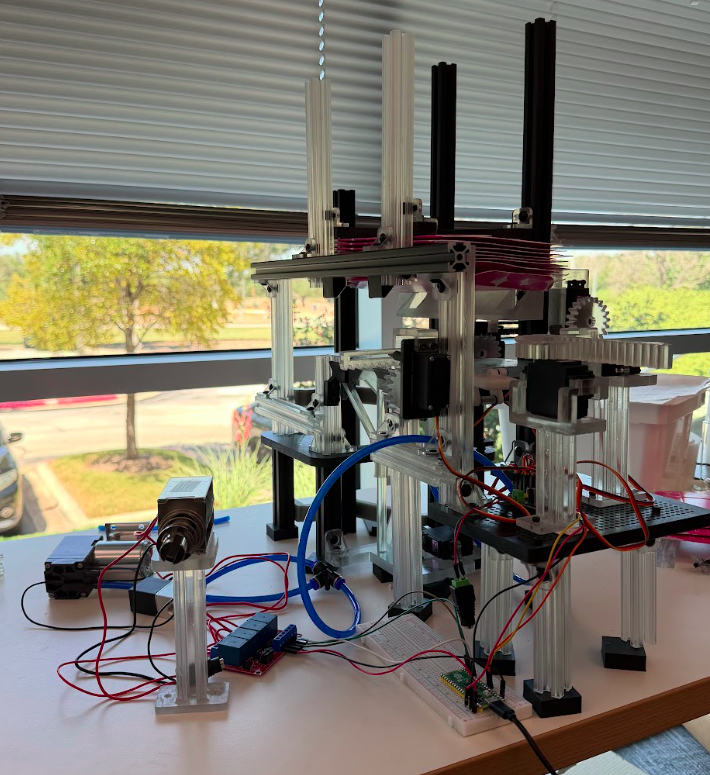
- Frame — 2020 T-slot aluminum rails on a 3D-printed base with alignment features
- Servo motor — drives the folding actuations
- Rack & pinion — converts servo rotation into the linear stroke needed for bottom folding
- Vacuum pump + suction cup — holds the box securely in position during feeding and folding
- Crank-slider — allows linear motion for pneumatic pump to feed box from stack to fold
Main actuation mechanisms were paired to the motion each fold step demands: a linkage drives bottom-folding, a rack & pinion for linear actuation.
Control System
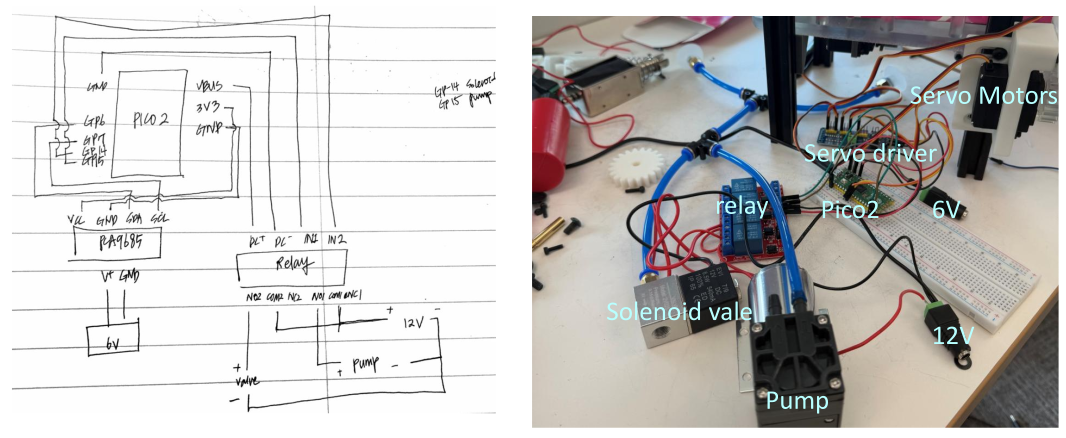
The station runs on MicroPython on a Raspberry Pi Pico 2. Servos are driven over I2C through a PCA9685 16-channel PWM driver, with the pump and solenoid valve switched through an optocoupled relay so the Pico’s GPIO never carries load current directly. Power is split across two isolated rails — 6V for the servos and driver, 12V for the pump and valve — sharing a common ground, with actuation sequenced rather than simultaneous to keep peak draw within each rail’s rating.
A small command interface (Run [stage], Set <servo> <value>, Pump on/off) drives an 12-step execution sequence per box:
- Feed the box
- Form the square
- Push the bottom fold down
- Fold side tabs in
- Half bottom fold (60°)
- Fold tuck tab in
- Pull side-tab fixtures out
- Second bottom fold to seat the tuck tab (80°)
- Pull the tuck flap out
- Final full bottom fold
- Move the box placement guide
- Drop the box
Future Work for the remainder of Internship
- Industrialization — move the design from a rapid prototype to a mechanism reliable enough for continuous use on an industrial manufacturing floor