Project Overview
This project implements a **Real-Time Dynamic Collision Prevention System** for the 7-DOF Franka Emika Panda.Evolution from Previous Work: While my Reactive Control project used Artificial Potential Fields (APF) to create soft repulsive forces that could lead to local minima or oscillations, this system upgrades to Control Barrier Functions (CBF). This approach treats safety as a hard mathematical constraint, guaranteeing collision freedom without altering the robot’s path unless absolutely necessary.
Tech Stack: ROS 2 Kilted, Python (Launch/Teleop), C++ (Solver), Pinocchio (Kinematics), ProxQP.

Two robotic arms moving in commanded velocities with and without my collision prevention layer
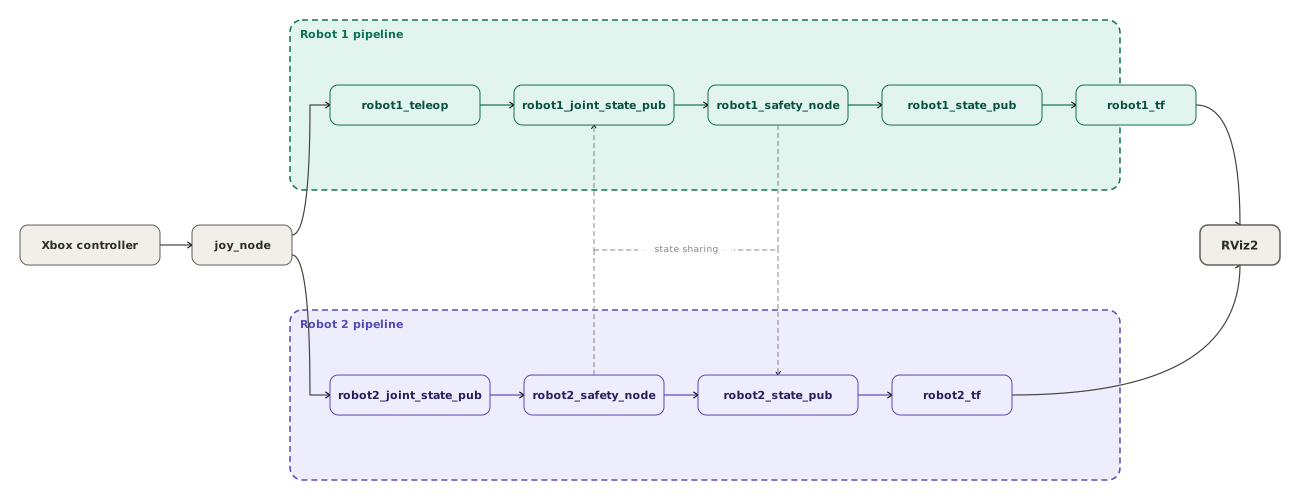
System Architecture
Core Node: /safety_node_cpp
- Inputs (Intention & State): Subscribes to
/joint_states_source(1kHz hardware states) and/teleop_vel(the desired user or global planner velocity commands). It also listens to/shared_obstaclefor dynamic hazard tracking. - Internal Processing Pipeline:
- Kinematic Update: Uses Pinocchio to compute forward kinematics, frame placements, joint Jacobians, and the Mass Matrix via CRBA.
- Geometric Evaluation: Models the robot using 8 overlapping capsules. Calculates point-to-segment and segment-to-segment distances algebraically to completely bypass the latency of heavy mesh-collision libraries.
- Constraint Formulation: Constructs the dense matrices ($C$, $l$, $u$) for Floor, Dynamic Obstacles, Inter-Robot collisions, and Self-Collisions.
- Optimization: Solves the constrained Quadratic Program using ProxQP.
- Outputs (Action): Publishes the mathematically verified safe velocity commands to the hardware controller, alongside RViz2 visualization markers.
Mathematical Foundation
Unlike standard kinematic safety filters, this implementation treats safety as a dynamic constraint. It accounts for the robot’s physical inertia and kinetic energy to guarantee it always has the stopping power required to avoid an impact.
1. The Energy-Aware Barrier Function ($h(x)$) Let $h(q)$ be the geometric distance between the robot capsule and a hazard. We define a dynamic barrier function $B(q, \dot{q})$ that couples this distance to the robot’s kinetic energy ($E_k$):
$$E_k = \frac{1}{2}\dot{q}^T M(q) \dot{q}$$$$B(q, \dot{q}) = \gamma \max(h(q), -0.05) - E_k$$To ensure the robot does not enter an unavoidable collision state, we enforce the derivative inequality $\dot{B} \ge -\alpha B$, which bounds the allowable kinetic energy relative to the distance to the obstacle.
2. High-Order Kinematic Constraints Because the robot is commanded at the acceleration level internally, we apply a PD-style High-Order CBF (HOCBF) to constrain the approach rate. Using the geometric Jacobian $J(q)$, the distance constraint is bounded by:
$$l_{kin} = -k_p h(q) - k_d \dot{h}(q)$$$$l_{kin} \le J(q) \ddot{q} \le \infty$$3. The Dense Quadratic Program (QP) The solver maps the user’s desired velocity into a desired acceleration $\ddot{q}_{des} = k_p(\dot{q}_{des} - \dot{q}_{safe})$ and finds the optimal safe acceleration ($\ddot{q}^*$) using ProxQP.
$$\min_{\ddot{q}} \frac{1}{2} || \ddot{q} - \ddot{q}_{des} ||^2$$Subject to:
- $L_{cbf} \le C_{cbf} \ddot{q} \le U_{cbf}$ (Energy and Geometry Bounds)
- $a_{min} \le \ddot{q} \le a_{max}$ (Hardware Acceleration Limits)
- $\dot{q}_{min} \le \dot{q} \le \dot{q}_{max}$ (Hardware Velocity Limits)
- $q_{min} \le q \le q_{max}$ (Hardware Joint Limits)
The optimal acceleration is integrated numerically ($v_{safe} = v_{safe} + \ddot{q}^* \Delta t$) and clamped to hardware limits before publishing.
Citation
- Reference: Singletary, A., Kolathaya, S., & Ames, A. D. “Safety-Critical Kinematic Control of Robotic Systems.” arXiv preprint arXiv:2009.09100, 2020. PDF